Welcome to The Divine Duty. Our journey begins.

India Leads Space Race With Worlds First 3D Printed Rocket Engine
India successfully launched the first rocket powered by a single piece 3D printed rocket engine on June 08 2026 marking a major shift in space technology.
Abhinav Kumar
6/9/2026
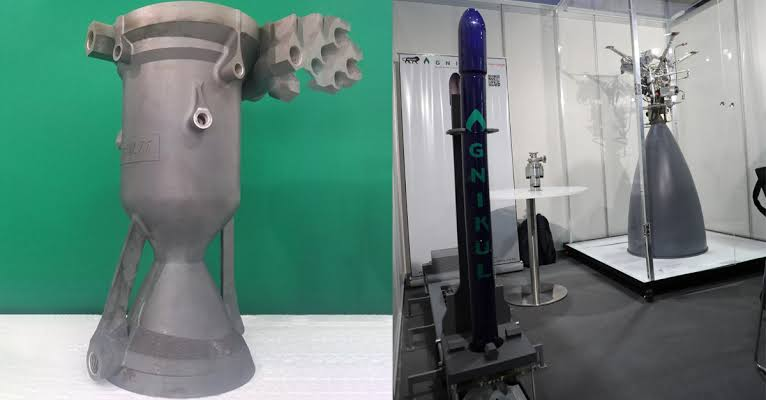
Agnilet single piece rocket engine. Source: Emerging Technology Market Intelligence Blog - Bis Research
On June 08 2026 India officially entered a new era of space exploration by launching the world first single piece 3D printed rocket engine. This achievement represents a departure from traditional aerospace manufacturing which typically relies on assembling hundreds of individual components. By successfully flying a rocket powered by an engine printed as a single unit the mission has demonstrated that additive manufacturing is no longer just a theoretical concept for high performance machinery. It is now a functional reality capable of withstanding the extreme pressures and temperatures of a space launch.
Background
The project emerged from the research ecosystem of Chennai where the startup Agnikul Cosmos has been operating since its inception within the IIT Madras incubator. The specific vehicle used for this flight is known as the Agnibaan SOrTeD which stands for Sub Orbital Technological Demonstrator. Unlike conventional rockets that require months of assembly and a massive supply chain for specialized parts this mission utilized a propulsion system designed and manufactured using advanced additive manufacturing techniques in Tamil Nadu.
The launch occurred at a dedicated private launch pad marking the first time a private Indian entity has managed such a sophisticated technological feat from start to finish. While larger space agencies have experimented with printed parts this particular engine is the first to be realized as a singular integrated piece of hardware to actually reach flight status.
The Engineering Logic Behind the Mission
The primary focus of this mission was the Agnilet engine. In standard liquid fueled rocket engines the cooling channels, injectors, and the combustion chamber are separate parts that must be welded or bolted together. This creates hundreds of potential failure points where joints might leak under pressure. The team at the IIT Madras incubator reimagined this entire structure as a single digital file.
By using a 3D printed rocket engine the engineers eliminated the need for complex assembly. The engine is printed using a specialized metal alloy that can handle the cryogenic temperatures of the fuel and the intense heat of combustion simultaneously. Because there are no seams or welds the structural integrity of the engine is significantly higher than its traditionally manufactured counterparts. This digital approach to manufacturing also allows for rapid iteration. If a design needs a slight adjustment for a different payload or mission profile the engineers can simply modify the software file and print a new version in a matter of days.
The Flight of June 08 2026
The countdown in Sriharikota was a culmination of years of rigorous ground testing. When the ignition sequence began on June 08 2026 the Agnibaan SOrTeD rose from its launch pad with a clear and steady plume. The flight was designed to validate the performance of the 3D printed rocket engine under real world conditions including the transition through various atmospheric layers where vibration and pressure are at their peak.
Data gathered during the ascent confirmed that the engine maintained its structural stability and thrust profile throughout the planned trajectory. The mission was not intended to reach a full orbital altitude but rather to serve as a proof of concept. The successful recovery of flight data has provided the aerospace community with the first concrete evidence that a fully printed engine can handle the rigors of launch without the need for traditional heavy assembly.
Impact on Space Accessibility
The significance of this flight extends far beyond a single successful launch. The use of a 3D printed rocket engine drastically reduces the time required to build a rocket. In the current global space economy the demand for small satellite launches is growing faster than the availability of rockets. Traditional manufacturing timelines often stretch into several months or even years for a single vehicle.
By moving to a printed model the production time for a rocket engine can be cut down to less than a week. This shift changes the economics of space. It allows for a launch on demand service model where startups and research institutions can book a flight and have their dedicated vehicle ready in a fraction of the usual time. The reduction in parts also means a reduction in mass which translates directly to higher fuel efficiency or the ability to carry larger payloads into a specific orbit.
Broader Context of Private Aerospace
This milestone reflects a wider transformation in the Indian aerospace sector. Over the last few years the government has opened up space technology to private players encouraging an environment where university incubators can transition into commercial powerhouses. The success of this 3D printed rocket engine is a direct result of that policy shift.
The global aerospace industry is currently watching India closely as it becomes a hub for low cost high reliability space solutions. Other nations are also exploring additive manufacturing but the integration of a single piece engine into a flight ready vehicle places India at the forefront of this specific technological niche. According to recent industry data the global market for 3D printed aerospace components is expected to grow significantly over the next decade as more companies move away from traditional subtractive manufacturing.
The Future of Additive Manufacturing in Orbit
The flight of the Agnibaan SOrTeD is likely the first step toward even more ambitious goals. If an entire engine can be printed on Earth there is a strong possibility that similar technology could eventually be used to manufacture parts in space or on other planetary surfaces. This would eliminate the need to transport every single spare part from Earth which is one of the biggest hurdles for long distance space travel.
For now the focus remains on perfecting the commercial application of this technology for satellite deployment. The data from the June 08 2026 flight will be used to refine the next generation of engines which are expected to be even larger and more powerful. The era of the assembled rocket is slowly giving way to the era of the printed rocket.
Significance of the Achievement
This historic flight reminds us that innovation often happens at the intersection of traditional engineering and digital creativity. By taking the complex geometry of a rocket engine and simplifying it into a single printed part the team in Chennai has removed a significant barrier to the stars. The 3D printed rocket engine is no longer a futuristic dream but a proven tool that will shape how we reach space in the coming years.
Related Stories
The Divine Duty © 2026
The Divine Duty shares inspiring stories, cultural heritage, documentaries, change makers, and human journeys that educate, preserve, and inspire.