Welcome to The Divine Duty. Our journey begins.

How a Chemistry Graduate Saved 600 Native Vegetable Seeds in Salem
Discover how Gokulraj, a 27-year-old chemistry postgraduate from Tamil Nadu, turned his 1.5-acre farm into a living repository for 600 native vegetable seeds.
Abhinav Kumar
6/9/2026
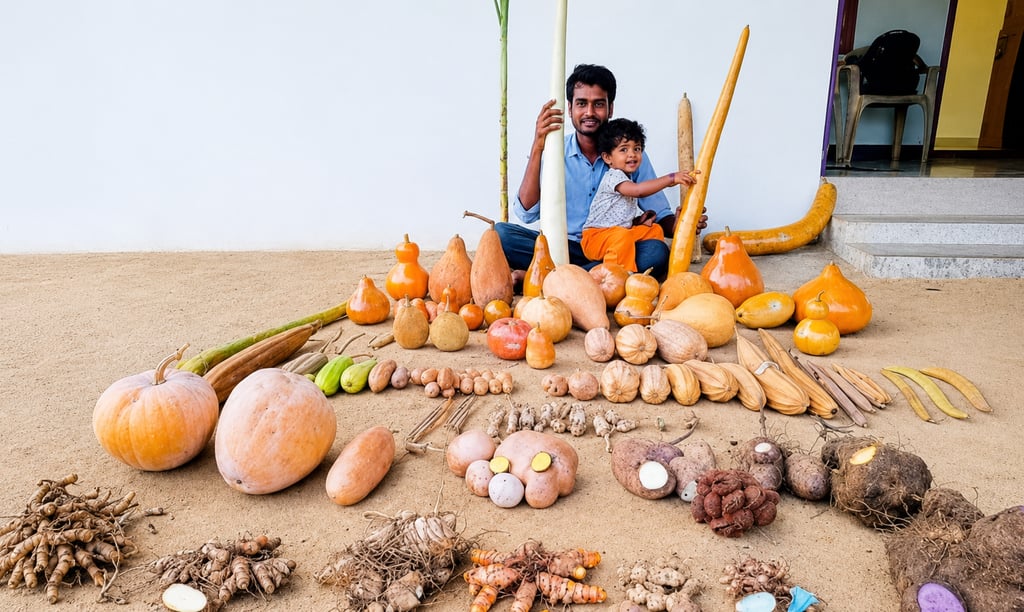
Native vegetable seeds preserved on a farm in Salem. (Please note: This image has been enhanced using AI for clarity and presentation).
At a time when advanced degrees usually lead to corporate laboratories or academic institutions, a 27-year-old chemistry postgraduate in Tamil Nadu chose to return to the soil. On a 1.5-acre plot in Kamalapuram village, Salem district, Gokulraj has cultivated a living repository of agricultural heritage. He has successfully collected and propagated over 600 native vegetable seeds. Instead of pursuing a conventional career, he dedicated his expertise to preserving heirloom crops that are quietly disappearing from Indian farms.
Leaving the Corporate Path Behind
Gokulraj holds a Master of Science in Chemistry. He never submitted a single job application after graduation. His focus shifted entirely toward the rapidly shrinking biodiversity of local agriculture. Across the country, commercial farming largely depends on a narrow selection of high-yield hybrid seeds. Recognizing the vulnerability of this system, Gokulraj began reaching out to traditional farmers, tribal communities, and online conservators to gather rare seeds before they were lost entirely.
His early farming attempts faced natural challenges. When his initial fields were vulnerable to flooding, he adapted by moving his cultivation to a slightly higher parcel of land. His persistence allowed his collection to grow steadily, reaching 100 varieties by the year 2020 and eventually expanding to his current massive inventory.
A Living Museum of Agriculture
His farm now visually resembles an open-air museum. The 1.5-acre land yields varieties that most modern consumers have never seen. He cultivates 25-kilogram Mayampatti pumpkins alongside four-foot-long bottle gourds and traditional snake gourds that grow up to seven feet. His tomato patches include a cherry variety that produces clusters of up to forty fruits on a single bunch, as well as unusual black-ribbed tomatoes that appear deep purple.
The diversity extends across all staple crops. He currently grows more than 60 varieties of brinjal, featuring shapes and colors ranging from deep violet to pure white, with some varieties naturally sweeter or containing fewer seeds. His collection also boasts 50 types of tomatoes, 35 varieties of beans, and over 50 distinct types of sweet potatoes in shades of purple, orange, yellow, and white.
Chemistry and Seed Preservation
Preserving 600 native vegetable seeds requires careful climate control, which can often demand expensive infrastructure. Gokulraj found an ingenious, low-cost solution right at home. He stores his seed boxes inside his traditional mud-walled house. The thick mud naturally regulates the indoor climate, maintaining a stable and cool temperature throughout the year. This traditional architecture ensures seed viability without the need for high-energy refrigeration.
His chemistry background plays a critical role in his daily cultivation methods. Understanding soil chemistry allows him to completely avoid synthetic chemicals. He relies exclusively on organic inputs like cow dung manure, fish amino acid formulations, and biofertilizers such as Trichoderma and Pseudomonas to maintain soil health and naturally manage pests.
The Economics of Native Vegetable Seeds
Seed conservation is often viewed purely as environmental activism, but Gokulraj has transformed it into a self-sustaining enterprise. He sells his surplus fresh vegetables at a traditional market in Salem, bringing in a steady monthly income. However, the core of his rural enterprise is the seed bank itself.
He packages and ships his native vegetable seeds to buyers across India. Prices remain highly accessible, ranging from twenty rupees for common varieties to one hundred rupees for the rarest specimens. This nationwide distribution network generates around 50,000 rupees in monthly revenue while ensuring that these traditional plants take root in new regions far beyond Tamil Nadu.
The Crisis of Lost Biodiversity
The steady loss of seed diversity represents a quiet crisis in modern agriculture. Over the last century, farming has shifted heavily toward standardized, commercially patented seeds. This shift often leaves farmers dependent on purchasing new seeds and chemical inputs every single season.
In contrast, native and heirloom seeds are open-pollinated. Farmers can save them after a harvest and replant them the following year, establishing independence from commercial supply chains. These traditional varieties have adapted over generations to survive local droughts, resist regional pests, and thrive in specific soil conditions. They also carry distinct nutritional profiles and flavors that are frequently bred out of commercial crops designed solely for long-distance transport. Once a native variety goes extinct, the unique genetic resilience it carries is impossible to recover.
Cultivating the Future
Gokulraj measures his success not by corporate milestones, but by the number of rare plants thriving in fields across the country. His decision to merge his scientific education with traditional farming practices offers a practical blueprint for rural agricultural startups. By safeguarding 600 native vegetable seeds, he is actively protecting the future of regional food security and proving that ecological conservation can be a highly viable livelihood.
Related Stories
The Divine Duty © 2026
The Divine Duty shares inspiring stories, cultural heritage, documentaries, change makers, and human journeys that educate, preserve, and inspire.